Programma Interreg IPA South Adriatic 2021–2027 (https://www.italy-albania-montenegro.eu/home)
Capofila: Unione dei Comuni del Basso Biferno
Durata: 01/07/2025 – 31/12/2027
Budget: 920.700,96 € (757.029,71 € cofinanziamento UE)
Panoramica del progetto
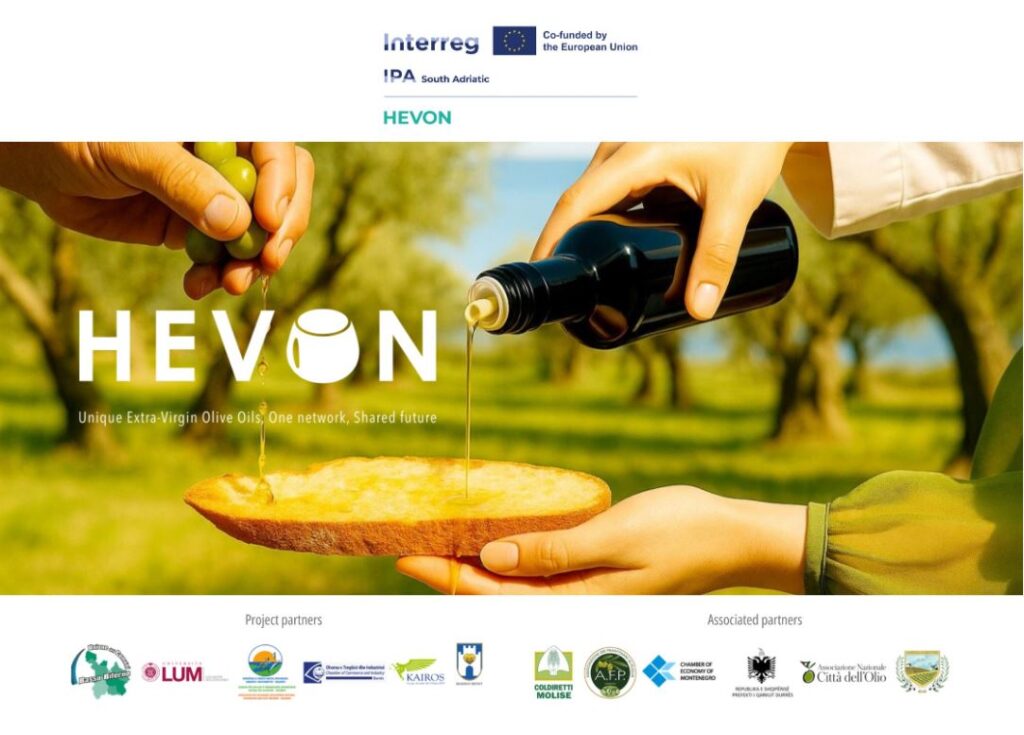
HEVON (High quality EVO oil Network of competitive MSMEs in South Adriatic) mira a rafforzare la competitività degli stakeholder italiani, albanesi e montenegrini nel settore dell’olio extravergine d’oliva (EVO) di alta qualità.
Il progetto mette in rete micro, piccole e medie imprese (MPMI) della filiera dell’olio EVO di Puglia, Molise, Albania e Montenegro, rafforzando la cooperazione transfrontaliera attraverso Living Lab ed eventi internazionali, offrendo strumenti dedicati di marketing e sessioni di formazione e coaching. Attraverso una strategia comune che comprende un Manifesto e una Carta degli Oli (Menu), il progetto offrirà ad enti locali, produttori e ristoratori strumenti innovativi per promuovere le proprie tradizioni culinarie e le varietà olivicole locali offrendo ai cittadini esperienze sensoriali e gustative uniche.
HEVON è co-finanziato dall’Unione Europea nell’ambito del Programma Interreg IPA South Adriatic 2021–2027.
Obiettivi generali
- Aumentare la consapevolezza sulle caratteristiche distintive dell’olio EVO di alta qualità.
- Migliorare la competitività delle MPMI con strategie innovative e di marketing.
- Rafforzare la collaborazione transfrontaliera e creare una filiera olivicola sostenibile.
- Promuovere politiche a sostegno di produttori, frantoiani, tecnici, ristoratori, policy maker e consumatori.
Target group
HEVON coinvolge tre principali attori della filiera EVO di alta qualità, ciascuno con benefici e strumenti dedicati:
- Produttori (MPMI della filiera olivicola e olearia)
- Maggiore consapevolezza sugli standard di qualità e strumenti per valorizzare l’olio EVO in ogni suo aspetto.
- Partecipazione a training, scambi, incontri B2B e utilizzo della piattaforma HEVON.
- Ristoranti e Agriturismi (settore HO.RE.CA.)
- Ambasciatori del valore culturale, gastronomico e salutistico dell’olio EVO.
- Coinvolti nei Living Lab, nella creazione del Menù e del Manifesto HEVON, oltre che in eventi promozionali.
- Consumatori (cittadini e visitatori)
- Scoperta dell’olio EVO come espressione di territorio, cultura e stile di vita sano.
- Coinvolgimento tramite World Café, fiere, esposizioni e attività dei Living Lab.
Attività principali
- Formazione HEVON
Sessioni di capacity building per produttori e operatori HORECA, volte a rafforzare competenze tecniche, strategie di marketing e competitività internazionale.
- HEVON Living Lab
Spazi di co-creazione che uniscono imprenditori, ristoratori, designer e cittadini per sviluppare il Carrello HEVON e il Menù HEVON.
- Sessioni locali in Italia, Albania e Montenegro.
- Tre eventi internazionali (due in presenza e uno online).
- Risultati: prototipo del Carrello per la promozione e il coinvolgimento dei consumatori e un Menù EVO condiviso.
- Tutoring, Incontri B2B & Piattaforma HEVON
- Attività di tutoring: aziende selezionate parteciperanno ad attività di tutoraggio al fine di favorire l’aumento della propria competitività nel mercato nel settore dell’olio extravergine d’oliva (EVO) di alta qualità e la loro internazionalizzazione, attraverso strategie di marketing e di comunicazione.
- Incontri B2B: aziende italiane, albanesi e montenegrine si incontreranno in Montenegro per agevolare la conoscenza tra aziende e professionisti e favorire future partnership economiche.
- La Piattaforma HEVON offrirà materiali formativi, una vetrina digitale e strumenti per rafforzare il posizionamento sui mercati nazionali e internazionali.
Il Kit HEVON
Un insieme di soluzioni innovative co-create con i beneficiari:
- Linee guida HEVON: standard condivisi per rafforzare la competitività delle MPMI.
- Carrello HEVON: strumento di comunicazione, formazione ed educazione del consumatore, utilizzato in ristoranti e fiere.
- Menu HEVON: selezione di oli EVO di alta qualità e sostenibili.
- Piattaforma HEVON: hub online per formazione, networking e visibilità internazionale.
I partner
Partner:
- LP1 – Unione dei Comuni Basso Biferno (Capofila, ITALIA)
- PP2 – Libera Università Mediterranea “Giuseppe Degennaro” (ITALIA)
- PP3 – Associazione per l’olivicoltura regionale sostenibile – Valdanos (MONTENEGRO)
- PP4 – Camera di Commercio e dell’Industria di Durazzo (ALBANIA)
- PP5 – KAIROS Cooperativa Sociale A.R.L. ONLUS – ETS (ITALIA)
- PP6 – Comune di Berat (ALBANIA)
Partner associati:
- AP1 – Federazione Regionale Coltivatori Diretti Molise (ITALIA)
- AP2 – AFP – Associazione Frantoiani di Puglia (ITALIA)
- AP3 – Camera di Commercio del Montenegro (MONTENEGRO)
- AP4 – Prefettura di Durazzo (ALBANIA)
- AP5 – Associazione nazionale Città dell’Olio (ITALIA)
- AP6 – Comune di Roskovec (ALBANIA)
Contatti: hevon.ucbb@gmail.com
ENG
HEVON – High quality EVO oil Network of competitive MSMEs in South Adriatic
Interreg IPA South Adriatic 2021–2027 Programme (https://www.italy-albania-montenegro.eu/home)
Lead Partner: Unione dei Comuni del Basso Biferno
Duration: 01/07/2025 – 31/12/2027
Budget: 920.700,96 € (757.029,71 € EU cofinancing)
Project Overview
HEVON aims to enhance the competitiveness of Italian, Albanian, and Montenegrin stakeholders in the high-quality extra virgin olive oil (EVOO) sector. The project connects micro, small, and medium-sized enterprises (MSMEs) across borders, supporting them with tailored tools, knowledge-sharing, and a joint strategy for innovation, sustainability, and market positioning.
HEVON is funded by the European Union under the Interreg IPA South Adriatic Programme 2021–2027.
General Objectives
- Increase awareness of the distinctive qualities of high-quality EVOO.
- Strengthen the competitiveness of MSMEs through innovation and improved marketing strategies.
- Enhance cross-border cooperation and create a more sustainable olive oil value chain.
- Promote policies that benefit producers, millers, technicians, restaurateurs, policy makers, and consumers.
Target Groups
HEVON engages three main actors of the EVOO value chain, each with specific roles and benefits:
- Producers (MSMEs in olive growing and oil milling)
- Gain awareness on quality standards and tools to valorize EVOO.
- Access training sessions, mobility exchanges, B2B meetings, and the HEVON Platform.
- Restaurants & Agritourism (HORECA sector)
- Act as cultural and educational ambassadors for EVOO.
- Participate in Living Labs, co-create the HEVON Menu and the HEVON Manifesto, and host promotional events.
- Consumers (citizens and visitors)
- Discover EVOO as an expression of territory, culture, and healthy living.
- Engage through World Cafés, fairs, exhibitions, and Living Lab activities.
Main Activities
- HEVON Training
Capacity-building sessions for producers and HORECA operators to strengthen technical knowledge, marketing strategies, and international competitiveness.
- HEVON Living Lab
A co-creation space bringing together entrepreneurs, restaurateurs, designers, and citizens to design the innovative HEVON Trolley and the HEVON Menu.
- Local sessions in Italy, Albania, and Montenegro.
- Three international events (two in person, one online).
- The outputs: a prototype Trolley for promotion and consumer engagement, and a shared EVOO Menu.
- B2B Meetings & HEVON Platform
- Manifestation of Interest (A1.1): 20–25 MSMEs per partner (producers & HORECA) will join mobility exchanges, training, and B2B events.
- The HEVON B2B Platform will provide training materials, a digital showcase, and tools to support market positioning nationally and internationally.
The HEVON Kit
A set of innovative solutions co-created with beneficiaries:
- HEVON Guidelines: shared standards to boost MSMEs’ competitiveness.
- HEVON Trolley: a communication and training tool for staff and consumers, to be used in restaurants and trade fairs.
- HEVON Menu: a curated selection of EVOOs meeting quality and sustainability criteria.
- HEVON Platform: an online hub for training, networking, and international visibility.
Partnership
Project Partners
• LP1 – Union of Lower Biferno Municipalities (Lead Partner, ITALY)
• PP2 – Giuseppe Degennaro Free Mediterranean University (ITALY)
• PP3 – Association for Sustainable Regional Olive Farming – Valdanos (MONTENEGRO)
• PP4 – Durres Chamber of Commerce and Industry (ALBANIA)
• PP5 – KAIROS Social Cooperative (ITALY)
• PP6 – Municipality of Berat (ALBANIA)
Associated Partners
• AP1 – Regional Federation Direct Farmers of Molise (ITALY)
• AP2 – AFP – Oil Masters Association of Puglia (ITALY)
• AP3 – Chamber of Economy of Montenegro (MONTENEGRO)
• AP4 – Prefect of Durres District (ALBANIA)
• AP5 – National Olive Oil Towns Association (ITALY)
• AP6 – Municipality of Roskovec (ALBANIA)
Contacts: hevon.ucbb@gmail.com
Nell’ambito di EVOLIO Expo 2026 – Fiera dell’Olio Extravergine di Oliva del Mediterraneo, si è svolto presso la Fiera del Levante di Bari il workshop “HEVON: Territori di Gusto e gastronomia del Benessere”, promosso nell’ambito del progetto Interreg IPA South Adriatic HEVON – High Quality EVO Oil Network of Competitive MSMEs in South Adriatic.
Find out more
Nella giornata del 19 marzo alle ore 11 è prevista presso l’Arena della Regione Puglia una prima sessione di Living Lab riservata ai partner di progetto e alle aziende nonché ristoranti selezionati della rete HEVON, cui farà seguito alle ore 14 presso la sala San Michele la conferenza pubblica dal titolo “Dal Frantoio alla Sala: l’Olio h-EVO-n come Linguaggio di Territori, Cultura e Strategia nel Ristorante Contemporaneo”.
Find out more